
Resursa, social club
Short summary

1870 r.

historicist industrial architecture

ul. 1 Maja 45, 96-300 Żyrardów

social club and cultural venue for factory officials and the local elite

cultural venue housing the Resursa Gallery, Tourist and Cultural Information Centre, restaurant and hotel rooms

interiors are accessible during exhibitions and events, and during the opening hours of the Tourist and Cultural Information Centre

The building description was prepared in consultation with the staff of the Museum of Western Mazovia in Żyrardów.
Discover the history
The Resursa was built in 1870 as a cultural institution and meeting place for officials of the Żyrardów Works, wealthy local residents and tenants of nearby landed estates. Its activities were modelled on the private social clubs popular in Western Europe, intended for members of the local elite.
Visitors to the Resursa had access to private rooms, a specialist library with a reading room, a billiard room and rooms for playing cards. Upstairs were reception rooms and an elegant ballroom, which also served as a theatre.
From 1895, the building housed a library for factory officials, containing mainly specialist literature for technical and administrative staff. The building was altered several times during the 1870s, 1880s and 1890s.
In 1905, a bowling alley was also built next to the Resursa, providing an additional recreational facility for the club.
During the German occupation, the building housed the so-called Deutsche Haus, which included a café, buffet, club rooms and the headquarters of an auxiliary police organisation. After the Second World War, the Resursa changed users many times. It housed, among other things, the Pioneer House, a clubroom for the children of employees of the Linen Works, the factory textile school and the factory cultural centre.
In 2001, the building was taken over by the town, and between 2009 and 2011 it underwent restoration and adaptation for cultural use. Today, the Resursa once again hosts exhibitions, concerts, meetings and other cultural events.
During the German occupation, the building housed the so-called Deutsche Haus, which included a café, buffet, club rooms and the headquarters of an auxiliary police organisation. After the Second World War, Resursa changed users several times. It housed, among other institutions, the Pioneer House, a day room for children of Linen Factory employees, a factory textile school and a factory cultural centre.
In 2001, the building was taken over by the city, and between 2009 and 2011 it underwent restoration and adaptation for cultural purposes. Today, Resursa once again hosts exhibitions, concerts, meetings and other cultural events.
Time travel
Architecture
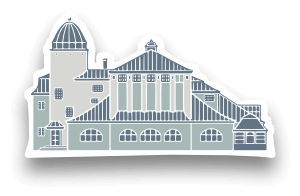
Resursa is a two-storey building constructed of red brick. Its form consists of the main block and two side wings added to the north during the extension carried out between 1899 and 1905. The symmetrical front façade has a regular arrangement of windows and is emphasised by a central section topped with a triangular gable.
The ground floor is distinguished by tall windows and entrance openings topped with semicircular arches. The first-floor windows have segmental arches. Decorative elements include brick cornices, friezes, window and door surrounds, and moulded details created through the careful arrangement of brick.
The ballroom retains the richest interior decoration. It was designed in a Renaissance-inspired style with Classical elements. Its walls are decorated with colourful paintings, gilding, pilasters, decorative cornices and panels. The representative character of the room is further emphasised by tall, semicircular windows and a richly decorated ceiling.
Gallery
Nearby
Sources
- Historic Monument Documentation Card
- Żyrardów Municipal Office Portal, Resursa with Bowling Alley
- Żyrardów Municipal Office Portal, Resursa
- National Heritage Institute, Zabytek.pl