Old Spinning Mill
Short summary

1830-1833

industrial brick architecture

Mały Rynek 7, 96-300 Żyrardów

mechanical flax spinning mill

mixed residential and commercial building

the commercial areas of the building are publicly accessible
The building description was prepared in consultation with the staff of the Museum of Western Mazovia in Żyrardów.
Discover the history
The history of the Old Spinning Mill is closely linked to the beginnings of Żyrardów’s linen industry. In 1829, the company “Karol Scholtz i Współka” was established, and a year later the Linen Products Society was formed and construction of the factory began in the village of Ruda Guzowska. The main spinning mill building, designed by the Warsaw architect Jan Jakub Gay, was built in 1830-1833.
Production began in 1833 under the supervision of the French engineer Philippe de Girard. The building was equipped with machinery and used methods of mechanical flax spinning developed by him. The settlement that grew around the factory was named Żyrardów after the inventor. The Old Spinning Mill was one of the largest and most modern production complexes in the Kingdom of Poland and Central Europe at the time.
In 1847, the indebted works were taken over by the Bank of Poland, and in 1857 they were purchased by Karol August Dittrich and Karol Teodor Hielle. This marked the beginning of a period of intensive expansion and modernisation of the factory. The Old Spinning Mill was repeatedly altered and adapted to changing production technologies. In later years, it was connected to the neighbouring New Spinning Mill by a covered walkway.
The building was rebuilt after wartime damage and modernised again after 1945. Linen production continued until the decline of the works in the 1990s. After the factory closed, the Old Spinning Mill lost its original function.
At the beginning of the 21st century, the building underwent extensive redevelopment. The main works on the central building were carried out between November 2008 and April 2010. The ground floor was converted into retail and service premises, while 73 flats were created on the upper floors. The complex is also now home to the Aparthotel Stara Przędzalnia.
Time travel
Architecture
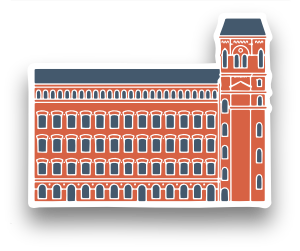
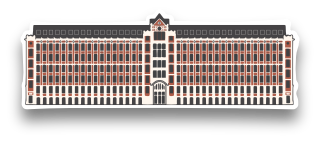
The Old Spinning Mill is a monumental five-storey factory building constructed of brick and partly rendered.
Its most distinctive features are the corner turrets at the top of the façades. One housed a clock, while the other contained a bell whose sound marked the rhythm of the day and called workers to work.
The appearance of the Old Spinning Mill changed as the works developed. The building was altered and extended several times. For example, around 1873 a south-west wing was added, later adapted into a weaving mill known as the “Onion” Weaving Mill.
The Old Spinning Mill was also connected to the neighbouring New Spinning Mill by a covered walkway, allowing people and materials to move between the two buildings.
During its modern conversion, the brick façades and the most important elements of the building’s industrial character were preserved, while the interiors were adapted for residential, retail, service and hotel use.